Post reply

Name:
Email:
Subject:
Message icon:

Verification:

shortcuts: hit alt+s to submit/post or alt+p to preview


Topic Summary

Posted by: 90sRetroFan
« on: December 18, 2025, 04:28:50 am »

Our message has reached Taiwan, which is now joining in to expose Russia's plan of ensuring China and Japan fight each other during WWII:

https://www.youtube.com/watch?v=bltvr0v78D8
Posted by: 90sRetroFan
« on: December 05, 2025, 07:54:58 pm »

Must watch:

https://www.youtube.com/watch?v=HqJBvhlHYuA

Contrary to the ending of the video, I still have no confidence that Eurocentrist Xi will turn on Russia. If he had any intention of doing so, he would be doing everything possible to avoid antagonizing China's neighbours to the east and south (which is exact opposite of what he is doing as we speak).
Posted by: 90sRetroFan
« on: November 28, 2025, 12:30:17 am »

https://www.youtube.com/watch?v=AnxtyoOl3TM

Woke comments:

Quote
Ohhh but they will, and china will will take the manchuria to, just let this Ukrain war drag out a little more.

Quote
All the Kuril Islands and the entire Sakhalin Island (Karifuto) are part of the Japanese archipelago.

Quote
Shakalin, Kuril islands, Kamchatka should belong to Japan. Nothing for Russia.

Quote
Japan should just TAKE those islands now.

Quote
All the Japanese have to do is to go and take back the Islands from Russia how hard could that be

Quote
there's a way to get it back, if the current russian federation break up and i believe the federation is on a path of fragmentation. As for outer manchuria, is possible china may get it back
Posted by: PotatoChip
« on: November 23, 2025, 01:12:23 pm »

How Stalin crippled China’s post-war recovery – Sarah Paine
Quote
Full episode:    • Sarah Paine — How Russia sabotaged China's... 

In the full lecture lecture, military historian Sarah Paine explains how Russia—and specifically Stalin—completely derailed China’s rise, slowing them down for over a century.

This lecture was particularly interesting to me because, in my opinion, the Chinese Civil War is 1 of the top 3 most important events of the 20th century. And to understand why it transpired as it did, you need to understand Stalin’s role in the whole thing.
https://www.youtube.com/watch?v=TGSPIaIJWlo

Comments:

Quote
The soviets did the same in Eastern Europe and Germany, their entire post war infrastructure is basicly build by gulag prisoners.
Quote
Lol at Sarah Paine referencing Young Frankenstein
Quote
With "liberators" like Russia....
Quote
Russia being dishonourable and aggressive nation? shocker !
Posted by: rp
« on: October 23, 2025, 07:27:03 pm »

https://x.com/blyaat13/status/1769994851733373403?t=ONOjkv34FiFbBlqqFBTYdg&s=19
Quote
Peter, Catherine, Paul, and Alexander, all these Russian tsars and tsarinas were eager to invade India and make us their subjects. But our Paj33t population has been brainwashed to believe that Russia is a friend, an exception to the Western European colonialists.


Posted by: 90sRetroFan
« on: June 24, 2025, 07:40:54 pm »

https://www.youtube.com/watch?v=UNT90coKeZI

Woke comment:

Quote
The border could've changed even more as Russians heavily invested into Manchuria and even launched a full-scale invasion in 1900. Only after their defeat in Russo-Japanese War in 1905 they withdrew their forces.

Quote
Li freely "gave" the upper half of Manchuria to Russia thinking they could stop Japan's ambition in mainland Asia.

Short version: Li was a Eurocentrist.  ::)
Posted by: 90sRetroFan
« on: March 10, 2025, 09:38:54 pm »

Quote
Vladimir Putin has sought to promote Russia as the leader of a global anti-colonial movement. This cynical move echoes earlier Soviet propaganda positioning the USSR as an enemy of Western imperialism. Crucially, it also whitewashes Russia’s long history of colonial expansion
...
At a September 2023 forum in Vladivostok, Putin stated that Russia had “never been a colonizer anywhere.” One month later, he told an international audience at the annual Valdai Discussion Club that “the era of colonial rule” was long over, before accusing the West of robbing the entire planet. “The history of the West is essentially a chronicle of endless expansion,” Putin declared without a hint of irony, despite ruling over what is by far the world’s largest country thanks to centuries of relentless imperial expansion.

Anybody with a basic knowledge of Russian history will recognize the absurdity of Putin’s efforts to portray his country as an ideological opponent of imperialism. Modern Russia includes vast territories conquered from the fifteenth century onward. During the Tsarist era, imperial Russia swallowed up numerous non-Russian nations and incorporated much of the northern Eurasian landmass, eventually reaching the Pacific Ocean.

Expansion into Siberia and the Caucasus provided generations of Russian rulers with access to valuable resources including oil, gas, gold, diamonds, timber, and much more. These natural treasures have been a primary source of Russia’s wealth for hundreds of years, representing a textbook example of colonial exploitation.

While the Russian imperial elite has enriched itself, the non-Russian peoples of the empire have received very little in exchange for the plunder of their natural resources. Indeed, these non-Russian regions remain among the poorest and most deprived areas of today’s Russian Federation. Putin has exploited this marginalization, recruiting disproportionately large numbers of soldiers from these regions for his invasion of Ukraine.
...
Surprisingly, the reluctance of modern Russia to confront the country’s imperial past has been mirrored by many Western academics and commentators, who have continued to overlook the issue of Russian colonialism despite the troubling imperialistic instincts of the Putin regime.
Posted by: 90sRetroFan
« on: November 09, 2024, 07:06:13 pm »

Posted by: antihellenistic
« on: May 23, 2024, 10:16:46 pm »

Russia is part of Western Civilization, including during their reign of Communism

Quote
Philippe Nemo’s claim that Russia is not really Western because under its Orthodox Christian order it did not experience the separation of church and state, and the rise of representative institutions, is wrong on racial grounds.[71] It is wrong on high cultural grounds as well: Russia has contributed one of the greatest literary traditions to the West, starting with Alexander Pushkin, the poetry of Mikhail Lermontov and Nikolay Nekrasov, dramas of Aleksandr Ostrovsky and Anton Chekhov, and the prose of Nikolai Gogol, Ivan Turgenev, Leo Tolstoy, Fyodor Dostoyevsky, and Ivan Goncharov. It is wrong on geopolitical grounds: Russia’s relentless geographical expansion into Siberia, beginning in the late-1500s and reaching the Pacific by 1639, is as deserving of admiration as the achievements of other well-known European explorations. Russia has been a land of numerous great explorers associated with heroic expeditions from Siberia to the Arctic into Space; it launched the first Earth-orbiting artificial satellite, the first human spaceflight in 1961, the first spacewalk in 1965, the first space exploration rover, on the Moon in 1970, and the first space station in 1971.[72] Guillaume Faye’s vision of a Euro-Siberia federation covering all European lands in between the Atlantic and the Pacific is a salutation to Russia’s geographical achievement and possible impending role in the struggle with the Asian world for the survival of Western civilisation.[73]

Source :

Faustian Man in a Multicultural Age by Ricardo Duchesne page 103 -104
Posted by: 90sRetroFan
« on: September 24, 2023, 06:02:36 pm »

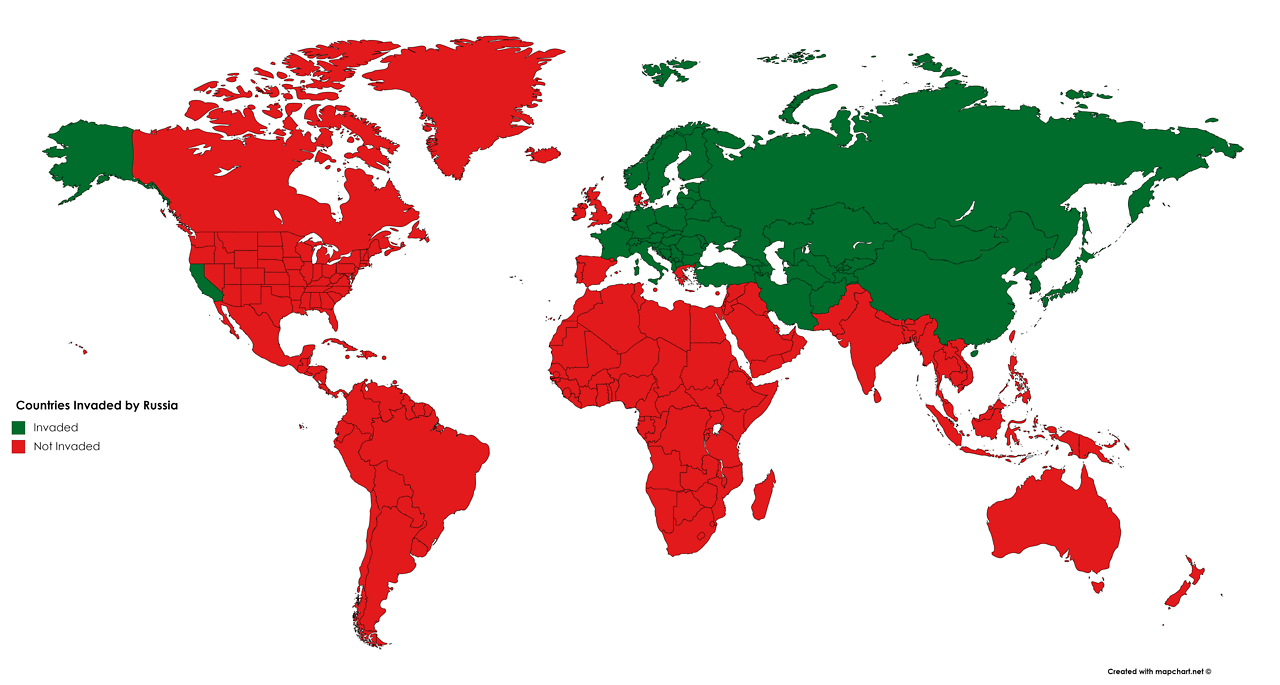
For reference:

Posted by: guest78
« on: November 28, 2022, 01:52:20 pm »

'Russia is a neo-imperialist state' undefeated they will attack again | Chip Chapman
https://www.youtube.com/watch?v=R4b91sY_GGQ

Decolonize Russia
Quote
To avoid more senseless bloodshed, the Kremlin must lose what empire it still retains.
Quote
The former national security adviser Zbigniew Brzezinski once said that without Ukraine, Russia would cease to be an empire. It’s a pithy statement, but it’s not true. Even if Vladimir Putin fails to wrest back Ukraine, his country will remain a haphazard amalgamation of regions and nations with hugely varied histories, cultures, and languages. The Kremlin will continue ruling over colonial holdings in places including Chechnya, Tatarstan, Siberia, and the Arctic.

Russia’s history is one of almost ceaseless expansion and colonization, and Russia is the last European empire that has resisted even basic decolonization efforts, such as granting subject populations autonomy and a meaningful voice in choosing the country’s leaders. And as we’ve seen in Ukraine, Russia is willing to resort to war to reconquer regions it views as its rightful possessions.
Quote
During and after the collapse of the Soviet Union, when the Russian empire hit its modern nadir, the United States refused to safeguard the newly won independence of multiple post-Soviet states, citing misplaced concerns about humiliating Moscow. Emboldened by the West’s reluctance, Moscow began to reclaim the lands it lost. Now Russia’s revanchism—aided by our inaction and broader ignorance of the history of Russian imperialism—has revived the possibility of nuclear conflict and instigated the worst security crisis the world has seen in decades. Once Ukraine staves off Russia’s attempt to recolonize it, the West must support full freedom for Russia’s imperial subjects.

The U.S. had an opportunity to unwind the Russian empire before. In September 1991, as the Soviet Union was falling apart, President George H. W. Bush convened his National Security Council. In the lead-up to the meeting, the White House seemed unsure how to handle the splintering superpower. Some of Bush’s closest advisers even called for trying to keep the Soviet Union together.

Defense Secretary Dick Cheney was not one of them. “We could get an authoritarian regime [in Russia] still,” he warned during the meeting. “I am concerned that a year or so from now, if it all goes sour, how we can answer that we did not do more.” His end goal was clear: as Deputy National Security Adviser Robert Gates later wrote, Cheney “wanted to see the dismantlement not only of the Soviet Union and the Russian empire but of Russia itself, so it could never again be a threat to the rest of the world.”

Bush demurred. Rather than accelerate the Soviet disintegration, he tried to avoid antagonizing Moscow, even as President Boris Yeltsin’s administration began pushing the anti-Ukrainian animus that Putin now embodies. For years—as Russia stabilized and eventually prospered, and as Cheney masterminded some of the most disastrous American foreign-policy decisions in recent decades—many believed that Bush had selected the better strategy. Armageddon, as one historian phrased it, was averted.
Entire article: https://www.theatlantic.com/ideas/archive/2022/05/russia-putin-colonization-ukraine-chechnya/639428/

I would like to see the full dismantling of Russia also, as I'm sure many more would like to see it now too.
Posted by: guest78
« on: November 26, 2022, 07:41:11 pm »

The Forgotten US Invasion of Russia
Quote
Decades before the beginning of the Cold War, the relationship between the US and the Soviet Government had already become heated. President Reagan had forgot to mention - or had simply forgotten - that American and Soviet troops had already engaged in active combat on several occasions, from August 1918 to April 1920. This is the story of the almost forgotten American invasion of Soviet Russia.
https://www.youtube.com/watch?v=1OUv3dXD0T4
Posted by: 90sRetroFan
« on: October 17, 2022, 02:46:23 am »

Today let's look at:


https://en.wikipedia.org/wiki/Russo-Persian_War_(1722%E2%80%931723)

Quote
The Russo-Persian War of 1722–1723, known in Russian historiography as the Persian campaign of Peter the Great,[9] was a war between the Russian Empire and Safavid Iran, triggered by the tsar's attempt to expand Russian influence in the Caspian and Caucasus regions and to prevent its rival, the Ottoman Empire, from territorial gains in the region at the expense of declining Safavid Iran.

The Russian victory ratified for Safavid Iran's cession of their territories in the North Caucasus, South Caucasus and contemporary northern Iran to Russia, comprising the cities of Derbent (southern Dagestan) and Baku and their nearby surrounding lands, as well as the provinces of Gilan, Shirvan, Mazandaran and Astarabad conform the Treaty of Saint Petersburg (1723).[8]

https://en.wikipedia.org/wiki/Treaty_of_Saint_Petersburg_(1723)

Quote
The Treaty of Saint Petersburg of 23 September [O.S. 12 September] 1723[1][2] concluded the Russo-Persian War of 1722-1723 between Imperial Russia and Safavid Iran. It ratified Iran's forced ceding of its territories in the North Caucasus, South Caucasus, and contemporary mainland Northern Iran, comprising Derbent (Dagestan), Baku, the respective surrounding lands of Shirvan, as well as the provinces of Gilan, Mazandaran, and Astarabad.[3] The treaty further specified that the Iranian king would receive Russian troops for domestic peacekeeping.[4]

As the Cambridge History of Iran states;

"On 23 September 1723, his ambassador in Saint Petersburg, Ismail Beg, signed a humiliating treaty which stipulated that the Tsar would accord the shah friendship and help against rebels and would maintain the shah in tranquil possession of his throne. In return the shah promised to permanently cede to Russia: ... the towns of Darband (Derbent), Baku, with all the territories belonging to them, as well as the provinces: Gilan, Mazandaran, and Astarabad

Quote
Peter was determined to keep the newly conquered Iranian territories in the Caucasus and northern mainland Iran. However, he was concerned about their safety and thus ordered the fortifications at Derbent and Holy Cross to be strengthened.[8] He was determined to attach Gilan and Mazandaran to Russia.[8] In May 1724, the Tsar wrote to Matiushkin, Russian commander in Rasht, that he should invite "Armenians and other Christians, if there are such, to Gilan and Mazandaran and settle them, while Muslims should be very quietly, so that they would not know it, diminished in number as much as possible."[8]

https://en.wikipedia.org/wiki/Russo-Persian_War_(1804%E2%80%931813)

Quote
The 1804–1813 Russo-Persian War was one of the many wars between the Persian Empire and Imperial Russia, and began like many of their wars as a territorial dispute. The new Persian king, Fath Ali Shah Qajar, wanted to consolidate the northernmost reaches of his kingdom—modern-day Georgia—which had been annexed by Tsar Paul I several years after the Russo-Persian War of 1796. Like his Persian counterpart, the Tsar Alexander I was also new to the throne and equally determined to control the disputed territories.

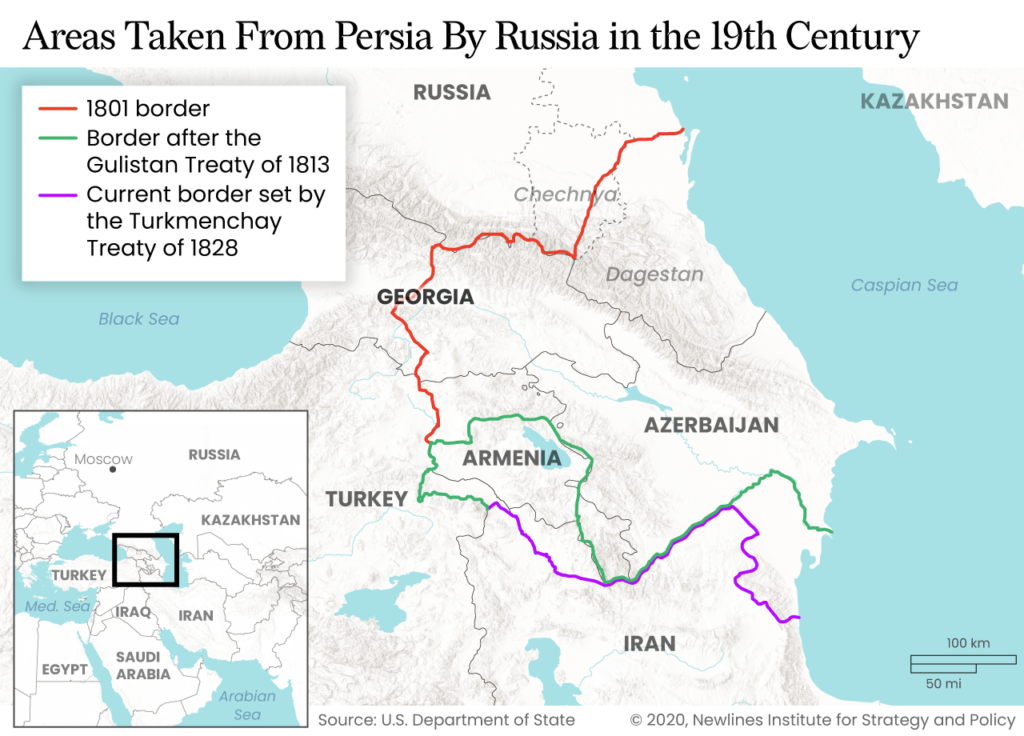
The war ended in 1813 with the Treaty of Gulistan which ceded the previously disputed territory of Georgia to Imperial Russia, and also the Iranian territories of Dagestan, most of what is nowadays Azerbaijan, and minor parts of Armenia.

https://en.wikipedia.org/wiki/Treaty_of_Gulistan

Quote
The Treaty of Gulistan (Russian: Гюлистанский договор; Persian: عهدنامه گلستان) was a peace treaty concluded between the Russian Empire and Iran on 24 October 1813 in the village of Gulistan (now in the Goranboy District of Azerbaijan) as a result of the first full-scale Russo-Persian War (1804 to 1813). The peace negotiations were precipitated by the successful storming of Lankaran by General Pyotr Kotlyarevsky on 1 January 1813. It was the first of the series of treaties (the last being the Akhal Treaty) signed between Qajar Iran and Imperial Russia that forced Persia to cede or recognize Russian influence over the territories that formerly were part of Iran.[1][2]

The treaty confirmed the ceding and inclusion of what is now Dagestan, eastern Georgia, most of the Republic of Azerbaijan and parts of northern Armenia from Iran into the Russian Empire.
...
Terms

"Russia by this instrument was confirmed in possession of all the khanates -- Karabagh, Ganja, Shekeen, Shirvan, Derbend, Kouba, and Baku, together with part of Talish and the fortress of Lenkoran. Persia further abandoned all pretensions to Daghestan, Georgia, Mingrelia, Imeretia, and Abkhazia."[18]
The lands include:
All the cities, towns, and villages of Georgia, including all the villages and towns on the coast of the Black Sea, such as:
Megrelia,
Abkhazia,
Imeretia,
Guria;
Almost all cities, towns, and villages of the khanates in the South Caucasus and partly North Caucasus:
Baku khanate,
Shirvan Khanate,
Derbent Khanate,
Karabakh khanate,
Ganja khanate,
Shaki Khanate,
Quba Khanate,
part of the Talysh Khanate;
Iran loses all rights to navigate the Caspian Sea, and Russia is granted exclusive rights to station its military fleet in the Caspian Sea.
...
Even today, Iran officially sees it and the later Treaty of Turkmenchay as some of its most humiliating treaties ever signed.

https://en.wikipedia.org/wiki/Russo-Persian_War_(1826%E2%80%931828)

Quote
The war had even more disastrous results for Persia than the 1804-1813 war, as the ensuing Treaty of Turkmenchay stripped Persia of its last remaining territories in the Caucasus, which comprised all of modern Armenia, the southern remainder of modern Azerbaijan, and modern Igdir in Turkey. Through the Gulistan and Turkmenchay treaties Persia lost all of its territories in the Caucasus to Russia. These territories had once extended throughout most of Transcaucasia and part of the North Caucasus.

The war marked the end of the era of the Russo-Persian Wars, with Russia now the unquestioned dominant power in the Caucasus. Persia (Iran) was forced to cede swaths of territories that it never regained. The conquered territories spent more than 160 years under Russian domination before establishing their independence, except Dagestan, which is still a Russian possession.

https://en.wikipedia.org/wiki/Treaty_of_Turkmenchay

Quote
The Treaty of Turkmenchay (Persian: عهدنامه ترکمنچای; Russian: Туркманчайский договор) was an agreement between Qajar Iran and the Russian Empire, which concluded the Russo-Persian War (1826–28). It was second of the series of treaties (the first was the 1813 Treaty of Gulistan and the last, the 1881 Treaty of Akhal) signed between Qajar Iran and Imperial Russia that forced Persia to cede or recognize Russian influence over the territories that formerly were part of Iran.[1][2]
...
Similarly to the 1813 Treaty of Gulistan, the treaty was imposed on Persia following a Russian military victory. Paskievich threatened to occupy Tehran in five days unless the treaty was signed.[4]
...
Following this treaty, as well as the Treaty of Gulistan, Russia had finished conquering all the Caucasus territories from Qajar Iran what is now Dagestan, eastern Georgia, Azerbaijan, and Armenia, all of which had formed part of its very concept for centuries.[5] The areas north of the Aras River, such as the territory of the contemporary nations of Georgia, Azerbaijan, Armenia and the North Caucasian Republic of Dagestan, were Iranian until they were occupied by Russia during the 19th century.[6][7][8][9][10][11]

Following the two treaties, the formerly Iranian territories came under the Russian, and later the Soviet control for approximately 180 years, and Dagestan remains a constituent republic within the Russian Federation to this day. Comprising most of the territory ceded in Gulistan and Turkmenchay treaties, three separate nations would gain independence following the dissolution of the Soviet Union in 1991: Georgia, Azerbaijan and Armenia.

NEVER FORGIVE. NEVER FORGET.

The only good part:

Quote
In the aftermath of the war and the signing of the treaty, anti-Russian sentiment in Persia was rampant. On 11 February 1829, an angry mob stormed the Russian embassy in Tehran and killed almost everyone inside. Among those killed in the massacre was the newly-appointed ambassador to Persia, Aleksander Griboyedov, a celebrated Russian playwright. Griboyedov had played an active role in negotiating the terms of the treaty.[21]
Posted by: 90sRetroFan
« on: September 23, 2022, 03:23:44 am »

A useful summary:

https://chinapower.csis.org/china-russia-relationship-weaknesses-mistrust/

Quote
In the 19th century, the Russian Empire was party to many of the “unequal treaties” that compelled China to hand over territory, money, and other spoils to European powers. The 1858 Treaty of Aigun and 1860 Treaty of Peking were particularly harsh, forcing China to forfeit approximately 1 million square kilometers (km) of territory to the Russian Empire.

Treaty of Kulja (1851)   Russia gained access to trade with areas in Xinjiang.
Treaty of Aigun (1858)   China forfeited over 600,000 square kilometers of land to Russia.
Treaty of Tientsin (1858)   Russia gained the right to trade with treaty ports by sea, as well as expanded extraterritoriality in treaty ports. Russia also established a legation in Beijing.
Treaty of Peking (1860)   China ceded large swaths of its northeastern territory to Russia.
Treaty of St. Petersburg (1881)   China paid Russia 9 million silver rubles. Russia expanded its consular network in Western China and Russian traders were allowed duty-free trade in Xinjiang and Mongolia.
Li-Lobanov Treaty (1896)   Russian warships gained access to Chinese ports. Russia was permitted to build a railway through Heilongjiang and Jilin Provinces and station troops to protect it. China reduced tariff rates on Russian goods.
Convention for the Lease of the Liaotung Peninsula (1898)   Russia was granted the lease to Port Arthur (in modern day Dalian) and Russian railways were permitted to extend to the port.
Boxer Protocol (1900)   China was forced to pay 450 million taels of silver to 8 powers, with the lion’s share (29 percent) going to Russia.
Sino-Soviet Border Conflicts (1968-1969)   China and Russia engaged in multiple border skirmishes, including at Zhenbao Island, where 72 were killed and 68 wounded on the Chinese side.

NEVER FORGIVE. NEVER FORGET.