https://www.chosun.com/english/national-en/2025/12/13/WWLXBPBL5FB77FNKLDP6LYGVQI/President Lee Jae-myung expressed agreement on the 12th with the need to strengthen Chinese character education
I agree. (Re-instituting Hanja would also presumably increase the global ratio of users of non-simplified form Chinese characters compared to simplified form, which is always good news.)
Background:
https://en.wikipedia.org/wiki/Debate_on_the_use_of_Korean_mixed_scriptIn November 1894, King Gojong declared that all texts in the Korean code of law should be written primarily in Hangul
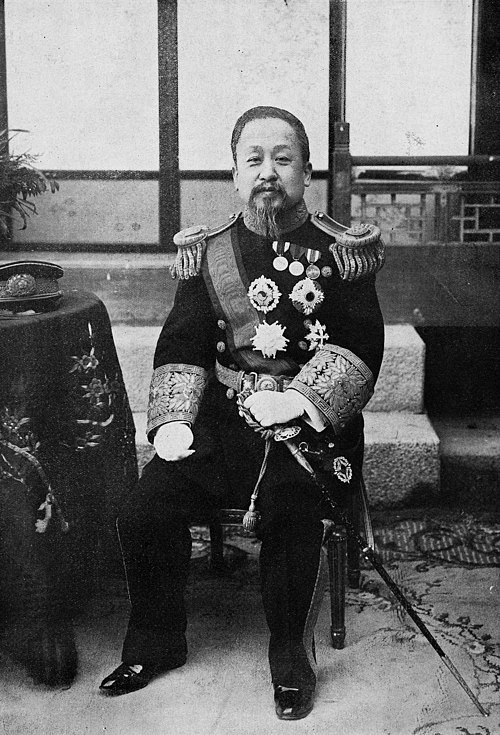
Eurocentrist Gojong also looked and dressed like what we would expect:
Functional illiteracy concerns with reading skills above the basic level necessary to manage daily life and employment. It is different from pure illiteracy, the measure discussed above, which is the inability to read at all. Some Korean education experts, including those in favor of Hangul-Hanja mixed script, have attributed the high rate of functional illiteracy to the lack of Hanja education in the Korean public education system. This claim is somewhat substantiated by the fact that 60-70% of the Korean vocabulary is derived from Hanja,[9] many of which appear more often in technical fields.
In a 2005 study, South Korean adults had the highest rate of functional illiteracy out of 22 OECD member states surveyed with a rate of 38%, much higher than the average of 22%.[10] Almost three in four Korean adults had difficulty reading information necessary for their occupation or skill.
Another Korean poll reports that 58% of college-aged Koreans, most of whom have never been taught Hanja, have felt inconvenienced by their lack of knowledge of Hanja at some point in their lives.[11]
A 2023 study by the Programme for the International Assessment of Adult Competencies (PIAAC) indicated that 31% of Koreans are not able to read and understand text above a basic level, and only 32% are able to read at level 3 or above. For reference, Japan, which continues to mix Kanji in its everyday orthography, has only 11% of its population be unable to read above a basic level, and 66% of Japanese adults can read at level 3 or above.[12] There is a notable disparity when broken down by age, particularly between younger generations and older generations, with older generations struggling more. However, the results are largely in line with the results from the 2011/2012 edition of the study,[13] indicating that Korean adults' literacy skills are deteriorating once they leave school. Part of this can be attributed to the lack of regular Chinese character education in Korean schools.
...
It is estimated that up to 60%[14] of the Korean vocabulary is composed of Sino-Korean words; according to these estimates, native Korean words form a minority of the vocabulary in the spoken Korean language.
Each character of Hanja conveys more information than each letter of Hangul as there are still many more Hanja characters than Hangul letters. The fact that Hanja conveys more information than Hangul has ramifications in the semantic meaning of each character. The word "일", for example, is composed of three Hangul letters ㅇ, ㅣ, and ㄹ. In only three letters, there is much ambiguity over the meaning of the Hangul block, as "일" could mean "one" (一) or "day" (日) in Sino-Korean vocabulary or a native Korean word for "work" (일). Writing the Hanja makes it clear which "일" is in question.
Similarly, when comparing the words 전부; 全部; lit. 'entirety' and 전쟁; 戰爭; lit. 'war', the "전" in both words describe the pronunciation of two completely different Hanja characters with different meanings.
As another example, Latin roots in the English language have very few homonyms. For example, words that have pyro- as a root will almost always mean fire. However, the Sino-Korean root for fire, 화 (火), shares the same Hangul spelling with many other roots.[c] As a result, many words as a whole are spelled identically in Hangul but vary widely in meaning.[d] The sheer number of homonyms causes severe limitations to vocabulary acquisition when homophonous words are being transcribed entirely phonetically, and purely phonetic transcription reduces understanding and depth of knowledge of Sino-Korean words.
Many Korean speakers cannot tell apart Sino-Korean words from “pure” Korean words, many Sino-Korean words are of Korean coinage, and many so-called “pure” Korean words were originally Sino-Korean words.[citation needed]
There is a large quantity of Sino-Korean words that are unique/exclusive to Korean or differ drastically in usage in comparison to Chinese or Japanese.
In addition to Sino-Korean words only used in Korean, many native Korean words are suggested to have originated from Sino-Korean words themselves, whose pronunciations have since deviated from their Hanja pronunciation. For instance, the word kimchi (김치) from 沈菜 (침채) has its origins in a Hanja word.
The use of Hanja allows easier interpretation of complex terms, as it is more helpful for the reader to assume an unknown vocabulary in context.[e]
Attempts to completely replace Hanja with native words have been made before; these attempts have ultimately returned to the use of Sino-Korean vocabulary.[15]
So why oppose Hanja?
Supporters of Hangul exclusivity argue that mixed script is an invention that was made and forced upon the Korean people by the Japanese during World War II.
It is logically impossible to "force" mixed script. Mixed script simply means both Hanja and Hangul are
permitted, therefore individual writers can still write in 100% Hangul if that is what they want to do, just as other individual writers can write in 100% Hanja, or any combination in between.
 Home
Home Search
 Login
Login Register