American architecture is clearly far superior to Western architecture, especially for those living in the Americas!:
Superadobe: Powerful SimplicitySuperAdobe is a form of earth bag architecture developed by architect and CalEarth founder Nader Khalili. Using long sandbags ("SuperAdobe Bags"), barbed wire, on-site earth and a few tools, Khalili devised a revolutionary building system that integrates traditional earth architecture with contemporary global safety requirements, and passes severe earthquake code tests in California.
This technology has been published by NASA, endorsed by the United Nations, featured in countless world media outlets, and awarded the prestigious Aga Khan Award for Architecture in 2004. It comes from years of meditation, hands-on research and development. Inspired by traditional earth architecture in the deserts of Iran and adapted for modern usage. Simplified so that anyone can build.
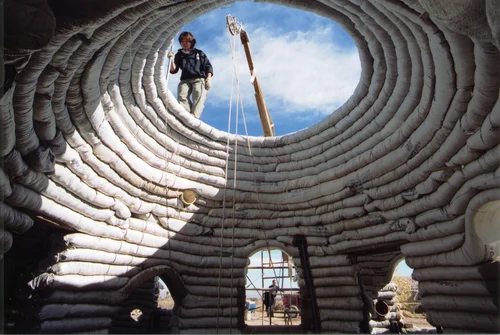
 SuperAdobe is a form of earth bag architecture developed by architect and CalEarth founder Nader Khalili. Using long sandbags ("SuperAdobe Bags"), barbed wire, on-site earth and a few ...
Survey of Damage to Historic Adobe Buildings after the January 1994 Northridge EarthquakeHistoric adobe buildings -Spanish colonial missions, Mexican rancho and pueblo adobe structures -are the only above-ground remains of the state’s initial settlement by Spain and Mexico in the eighteenth and nineteenth centuries. They are invaluable reminders of a time past when California was sparsely populated by Native Americans, who, at the direction of the first Hispanic colonizers, constructed the majority of
these buildings. Native American mission-trained adobe makers, masons, and carpenters continued to comprise the bulk of the labor force throughout the Hispanic era in California.
California’s historic adobe buildings are the state’s earliest and most vulnerable structures. They are subject to damage by the elements, perhaps most dramatically by earthquakes. Continued preservation of California’s Hispanic-era adobe architecture represents a significant challenge given the severity and frequency of earthquakes in recent years and the susceptibility of unreinforced adobe masonry to earthquake damage.
A wide range of opinions exist concerning the performance of historic adobe buildings during large earthquakes. There are those who consistently underestimate the potential of earthquakes to damage historic adobe buildings because these structures are thought to have successfully stood the test of time. There are others who overestimate the hazards posed, believing that historic adobe buildings are weak and incapable of
withstanding earthquakes under any circumstance. While adobe buildings are undeniably vulnerable to seismic events, some have survived major earthquakes, which points up the fact that their performance in earthquakes is not widely understood, nor is the dramatic effect of well-designed retrofit measures.
https://www.getty.edu/conservation/publications_resources/pdf_publications/pdf/adobe_northridge.pdfUMaine-led research in northern Peru unearths oldest adobe architecture in the AmericasOn the north coast of Peru, researchers have discovered the oldest adobe architecture in the Americas, constructed with ancient mud bricks carved from natural clay deposits created by floods caused by El Nino.
The pre-Hispanic bricks — carved from sedimentary layers versus created by mixing clay, temper and water — date the invention of adobe architecture to more than 5,100 years ago, according to the international research team led by archaeologist Ana Cecilia Mauricio.
In the Andes, early adobe monumental structures are associated with communal ceremonies and the rise of social complexity, the team notes.
On the north coast of Peru, researchers have discovered the oldest adobe architecture in the Americas, constructed with ancient mud bricks carved from natural clay deposits created by floods caused...
The Arg-e Bam (Persian: ارگ بم), located in the city of Bam, Kerman Province of southeastern Iran, is the largest adobe building in the world. The entire building was a large fortress containing the citadel, but because the citadel dominates the ruins, the entire fortress is now named Bam Citadel.
Listed by UNESCO as part of the World Heritage Site "Bam and its Cultural Landscape", it can be traced back to at least the Achaemenid Empire (sixth to fourth centuries BC). The citadel rose to importance from the seventh to eleventh centuries, as a crossroads along the Silk Road and other important trade routes, and as a producer of silk and cotton garments.[1]
On 26 December 2003, the Citadel was almost completely destroyed by an earthquake, along with much of the rest of Bam and its environs. A few days after the earthquake, the President of Iran, Mohammad Khatami, announced that the Citadel would be rebuilt.

Compared to Western civilization: (Take into consideration what I've posted above and how this Westerner talks about Western civilization:)
The Pantheon: The ancient building still being used after 2,000 yearsWhen visitors walk into the Pantheon in Rome and encounter its colossal dome, they may experience the same theatricality as its guests nearly 2,000 years ago.
"Anyone who steps inside the Pantheon immediately feels the crushing weight of human history, but also the incredible lightness of human creativity," said John Ochsendorf, professor of architecture at MIT and former director of the American Academy in Rome.
An architectural marvel of the Roman Empire, the Pantheon still sparks wonder today.
 Home
Home Search
 Login
Login Register