Duchesne back again:
Fact: 79 percent of the world’s most important inventions, including political institutions, modern technological innovations in medicine, agriculture and industrial technologies, and a moral order based on reason, moral universalism, and the rule of law came from Britain, France, Germany, Italy and/or the United States. These facts are irrefutable, and any attempt to reject them as false is an attempt to rewrite what had been the settled historical record. However, most leftist students view these realities as nothing more than White, self-congratulatory back-patting.
I will trivially refute it right here. Moral universalism views includes concern for non-humans, which Western civilization does not. For example, how many of the innovations in Western medicine which Duchesne is so proud of came about from Western scientists experimenting on non-consenting non-humans? Therefore indeed Duchese is doing nothing more than "white", self-congratulatory back-patting.
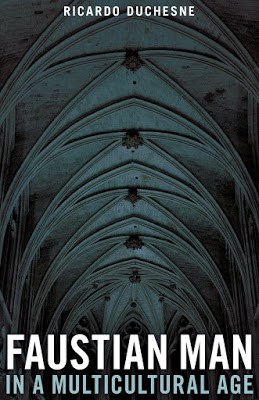
Duchesne’s recent book, Faustian Man in a Multicultural Age, is a continuation of his seminal 2011 book, The Uniqueness of Western Civilization (reviewed here). In that research and subsequent book Duchesne argued that Western Civilization is responsible for the world’s greatest innovations, technologies, and ideas as a result of not only the West’s ability to create something of intrinsic value from nothing, due, in large part, to the tenets of certain native Western philosophies, but, more importantly, the West’s burn-the-candle-at-both-ends work ethic, never-say-die character, their commitment to rational thinking, their inquisitiveness and willingness to explore.
I agree, except: 1) what was created has negative intrinsic value, in other words, the world was better before any of it was created; 2) "empirical", not "rational".
The opening chapter of Faustian Man is replete with the idea that White, Western men made the greatest leaps in human history—the leaps also Duchesne discussed in Uniqueness.
...
In Faustian Man, Duchesne incorporates this cyclical view within his theory of the West as a continually advancing civilization, while arguing that if current immigration replacement trends continue, and the White race is utterly marginalized, Western civilization will die out completely.
This is why is it a moral imperative that current immigration replacement trends must continue and "whites" be utterly marginalized. Western civilization absolutely deserves to die out completely and must be made to die out completely at any cost. With that said, I am more pessimistic than Duchesne. I am worried that Western civilization might survive even if "whites" become utterly marginalized. To be safe, Westernized "non-whites" must also be marginalized.
Huntington rightfully proclaimed that “Western values were particular to the West and alien to other cultures” (12). However, Huntington could not come to terms with the idea that the West, like other civilizations, had an ethnic identity. In other words, while Huntington argued that Western ideas of liberalism, citizenship, and democratization were universal regardless of the West’s ethnic ties to White Europe, Huntington had no problem identifying other civilizations in terms of their ethnic identities, rather than focusing only, as he did for the West, on their “cultural attributes” (12). While the ideas we associate with liberalism are framed in a universalist language, Duchesne argues that we should not ignore the fact that they developed in a civilization with a particular ethnic identity.
What Duchesne ignores is that from the colonial era onwards, Westernization altered the selective pressures for bloodline survival within colonized ethnicities. Thus within those ethnicities can be expected to be many more Western-compatible bloodlines by now than there were prior to the colonial era.
I want to point out something else, however, namely Duchesne's positive use of the term "Faustian" (also used by numerous other rightist propagandists) to describe "whites":
What is the story of Faust?
The erudite Faust is highly successful yet dissatisfied with his life, which leads him to make a pact with the Devil at a crossroads, exchanging his soul for unlimited knowledge and worldly pleasures. The Faust legend has been the basis for many literary, artistic, cinematic, and musical works that have reinterpreted it through the ages. "Faust" and the adjective "Faustian" imply sacrificing spiritual values for power, knowledge, or material gain.[1]
Yeah, that sounds about accurate. So, in short, our enemies
proudly advertize that they are Devil-worshippers. Of course we already knew they were Devil-worshippers based on what Western civilization looks like, but it is nice that they themselves admit it.
 Home
Home Search
 Login
Login Register