The first question we should ask is: what is Renaissance Revival architecture doing in FLORIDA?? How is it even "Revival" considering that Florida never had built in such a style prior to the colonial era?
As for the architecture itself, it is no coincidence that the parts that the presenter is most impressed by (e.g. the club room) are actually the worst parts.
More information about Renaissance Revival is available here:
Can you guess who else is a fan of this style?
The staircase at Mentmore Towers designed by Joseph Paxton, and the one at the Warsaw University of Technology designed by Bronisław Rogóyski and Stefan Szyller (late 19th century), both rise from pastiches of true Renaissance courtyards. Both staircases seem more akin to Balthasar Neumann's great Baroque staircase at the Würzburg Residenz than anything found in a true Renaissance Palazzo. The apparent Baroque style staircase at Mentmore is not without a Renaissance influence, its first flight is similar to "The staircase of the Giants" rises from the Doge's Palace Courtyard, designed when the Venetian Gothic was being uncomfortably merged with Renaissance style. Similarly to that at Mentmore, the Staircase of the Giant's terminates on to an arcaded loggia. Perhaps not ironically the Hall and Staircase at Mentmore were designed by Paxton to display furniture formerly housed in the Doge's Palace.
Answer:
Mentmore Towers, historically known simply as "Mentmore", is a 19th-century English country house built between 1852 and 1854 for the Rothschild family in the village of Mentmore in Buckinghamshire. Sir Joseph Paxton and his son-in-law, George Henry Stokes,[1][2] designed the building in the 19th-century revival of late 16th and early 17th-century Elizabethan and Jacobean styles called Jacobethan.[3][4] The house was designed for the banker and collector of fine art Baron Mayer de Rothschild as a country home, and as a display case for his collection of fine art. The mansion has been described as one of the greatest houses of the Victorian era.[5][6]

The Rothschilds are such renowned patrons of the style that they got it named after themselves:
Le Goût Rothschild, (pronounced [lə ɡu ʁɔtˈʃild]; English: the Rothschild taste), describes a detailed, elaborate style of interior decoration and living which had its origin in France, Britain, Austria, and Germany during the nineteenth century, when the rich, famous, and powerful Rothschild family was at its height. The Rothschild aesthetic and life-style later influenced other rich and powerful families, including the Vanderbilts, Astors, and Rockefellers, and became hallmarks of the American Gilded Age. Aspects of le goût Rothschild continued into the twentieth century, affecting such designers as Yves Saint Laurent and Robert Denning.
Characteristics
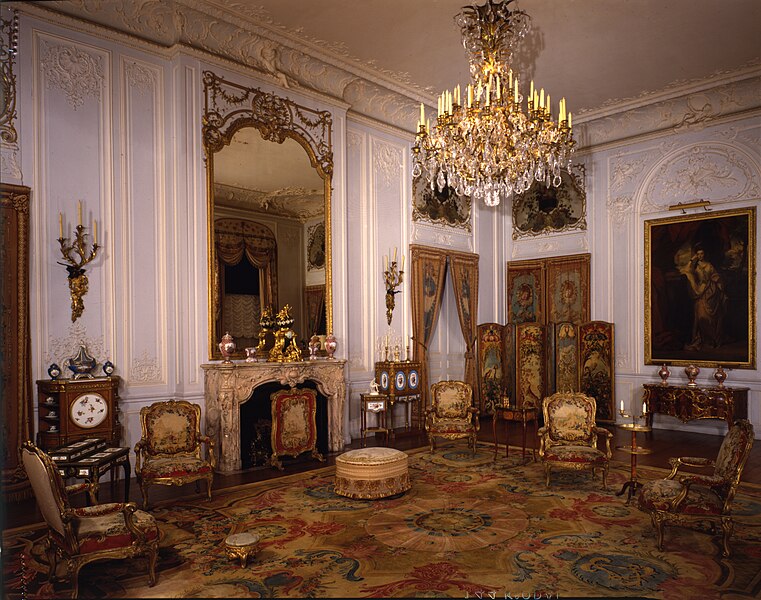
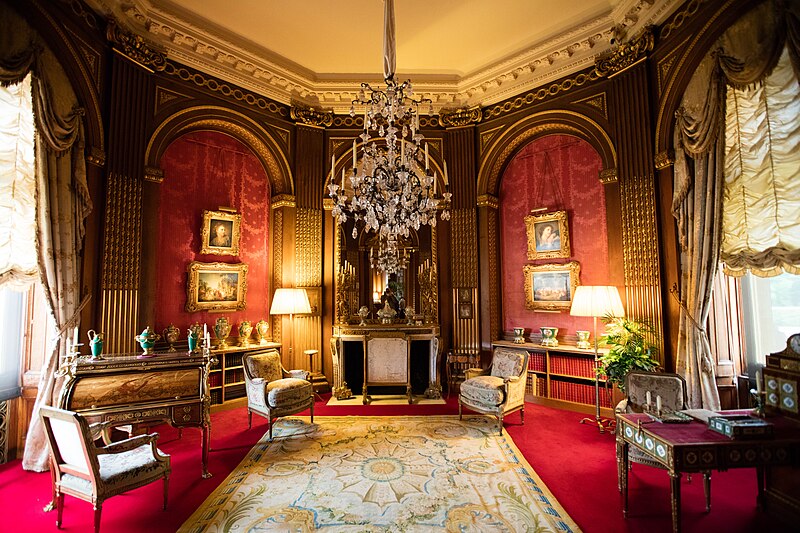
The decorative interior elements of the "Goût Rothschild" include lavish use of extravagant heavy textile fabrics (like damask, brocade, and velvet) and much gilding, elaborate stucco ceilings, and precious (and often antique) wooden panelling and parquet flooring. This heavy abundance is combined with eighteenth-century, mostly French, furniture. For the Rothschilds, furniture and works of art often were of royal provenance. The family bought only the best which was on the market at that time, with preference for the reigns of Louis XIV, Louis XV, and Louis XVI. And not so long ago after the French Revolution in 1789, there were some excellent pieces to buy, including many from the Château de Versailles. In architecture, the Rothschilds preferred styles of the Renaissance. The fusion of these uses of materials and styles, "the Rothschild style", combines a sense of Victorian horror vacui beside masterworks of art, sculpture, and armour.
With the construction of Waddesdon Manor, the newly established English branch of the Rothschild family revived imitation of French Renaissance styles in the United Kingdom. The expansive manor house was built in the tradition of the châteaux in the Loire Valley. The Rothschilds often bought original architectural elements from neglected castles and palaces and re-used these floors, fireplaces, ceilings, doors, and panellings in their own newly built castles and palaces, as, for example, in Mentmore Towers, Waddesdon Manor, the Château de Ferrières, and the Villa Ephrussi de Rothschild at Saint-Jean-Cap-Ferrat.






See also:
https://en.wikipedia.org/wiki/Category:Rothschild_family_residences
 Home
Home Search
 Login
Login Register